The truth facts about Puerto Rico
Puerto Rico (abbreviated PR),officially the Commonwealth of Puerto Rico, is a self-governing Caribbean archipelago and island organized as an unincorporated territory of the United States under the designation of commonwealth. Located about 1,000 miles (1,600 km) southeast of Miami, Florida, between the Dominican Republic in the Greater Antilles and the U.S. Virgin Islands in the Lesser Antilles, it consists of the eponymous main island and numerous smaller islands, including Vieques, Culebra, and Mona. With approximately 3.2 million residents, it is divided into 78 municipalities, of which the most populous is the capital municipality of San Juan, followed by those within the San Juan metropolitan area. Spanish and English are the official languages of the government, though Spanish predominates.
Puerto Rico was settled by a succession of Amerindian peoples beginning 2,000 to 4,000 years ago; these included the Ortoiroid, Saladoid, and Taíno. It was claimed by Spain following the arrival of Christopher Columbus in 1493 and subsequently colonized by Juan Ponce de León in 1508. Puerto Rico was contested by other European powers into the 18th century but remained a Spanish possession for the next 400 years. The decline of the Indigenous population, followed by an influx of Spanish settlers, primarily from the Canary Islands and Andalusia, and African slaves vastly changed the cultural and demographic landscape of the archipelago. Within the Spanish Empire, Puerto Rico played a secondary but strategically significant role compared to larger and wealthier colonies like Peru and New Spain. By the late 19th century, a distinct Puerto Rican identity began to emerge, centered on a fusion of European, African, and Indigenous elements. In 1898, following the Spanish–American War, Puerto Rico was acquired by the United States.
Puerto Ricans have been U.S. citizens since 1917 and can move freely between the archipelago and the mainland.[31] However, residents of Puerto Rico are disenfranchised from federal elections and generally do not pay federal income tax. In common with four other territories, Puerto Rico sends a nonvoting representative to the U.S. Congress, called a Resident Commissioner, and participates in presidential primaries; as it is not a state, Puerto Rico does not have a vote in the U.S. Congress, which oversees it under the Puerto Rico Federal Relations Act of 1950. Congress approved a territorial constitution in 1952, allowing residents of the archipelago to elect a governor in addition to a senate and house of representatives. The political status of Puerto Rico is an ongoing debate.
Beginning in the mid-20th century, the U.S. government, together with the Puerto Rico Industrial Development Company, launched a series of economic projects to develop Puerto Rico into an industrial high-income economy. It is classified by the International Monetary Fund as a developed jurisdiction with an advanced, high-income economy; it ranks 47th on the Human Development Index. The major sectors of Puerto Rico's economy are manufacturing, primarily pharmaceuticals, petrochemicals, and electronics, followed by services, namely tourism and hospitality.
About Puerto Rican Culture
Puerto Rican culture is a vibrant fusion of Taíno, Spanish, and African influences, characterized by strong family ties, a love for music and dance like salsa, and a rich culinary tradition featuring dishes such as mofongo. It is also a culture that embraces hospitality, respects dignity, and is reflected in colorful festivals and passionate artistic expression, including murals and music like bomba and plena.
Key cultural aspects
Family and community: Family is central to Puerto Rican life, with extended families living in close proximity and providing a strong support system. Community and hospitality are highly valued, and home is often the center of social celebrations.
Music and dance: Music is a vital part of the culture, with rhythms like salsa, bomba, and plena deeply embedded in the island's identity. Dances often tell stories and feature vibrant costumes.
Cuisine: Puerto Rican food reflects its diverse heritage, with popular dishes like mofongo (mashed plantains) and lechón (roast pork).
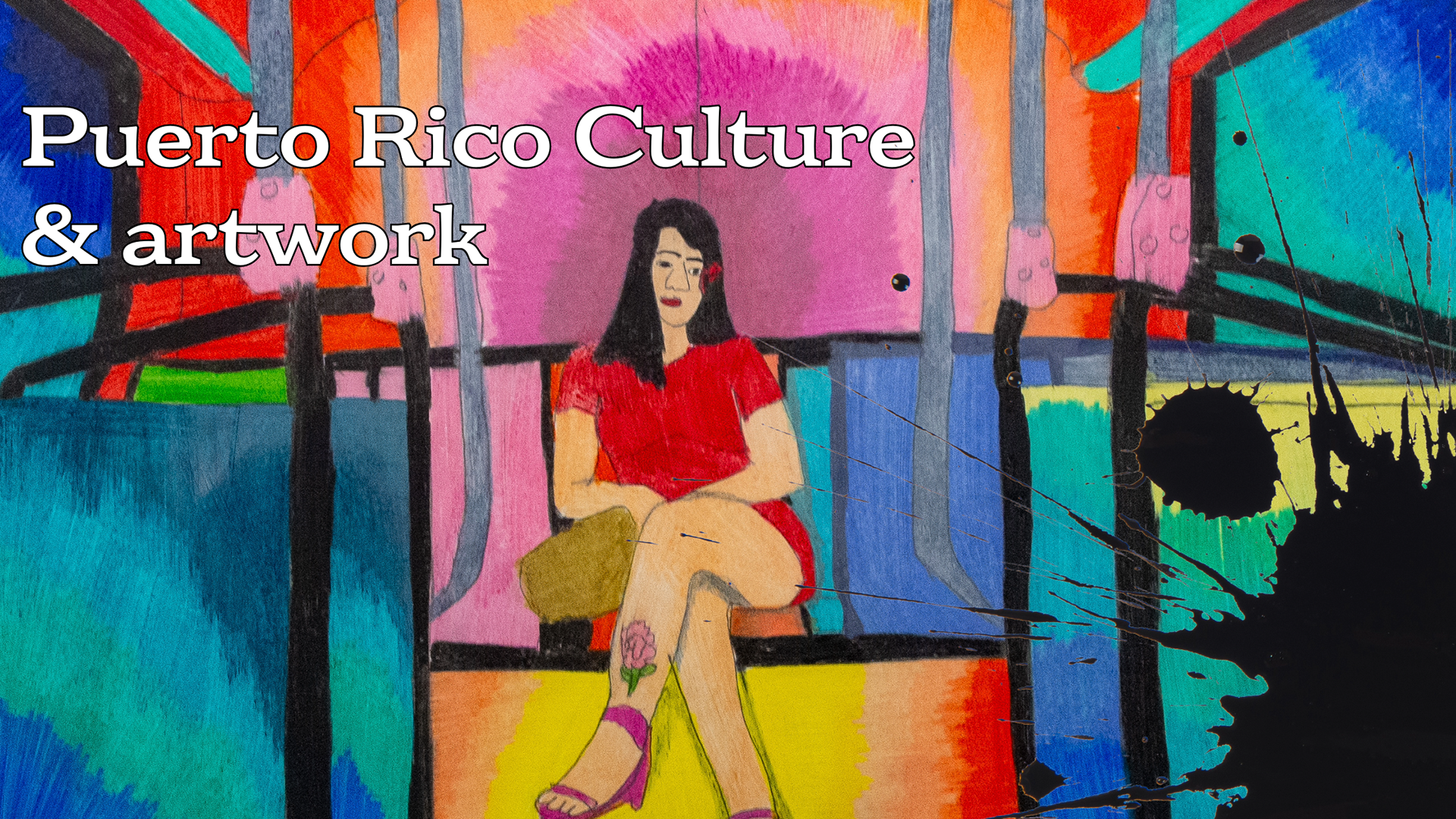
Art: The island has a rich artistic scene, from traditional art museums and galleries to vibrant street murals that can give communities a sense of pride and history.
Religion: Catholicism is a legacy of the Spanish colonial period and remains a significant influence, with frequent celebrations like patron saint festivals taking place across the island.
Language: Spanish is the most commonly spoken language, though English is also an official language and widely understood, especially in tourist areas. The blend of the two is often referred to as "Spanglish".